Guassa Gelada Research Project
About the Project, Field Site, Geladas, Research, Gelada Camp, Day to Day Life at Camp, Opportunities for Field Research
About the Project
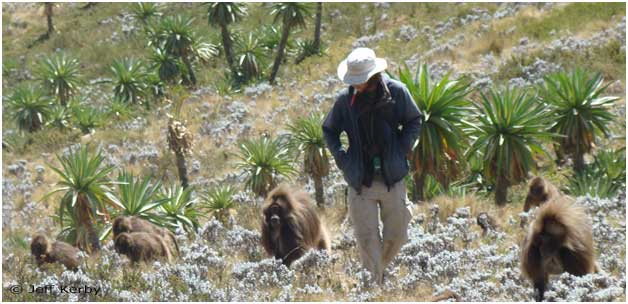
The Guassa Gelada Research Project is a long-term study of a wild population of gelada monkeys (Theropithecus gelada) at Guassa, Ethiopia, the largest remaining expanse of naturalistic gelada habitat in the world. Guassa is located in north-central Ethiopia in the Horn of Africa region. Currently, the Project focuses on the demography, reproduction, behavior and ecology of a single band of geladas living in Guassa’s southern sector. Since the Project’s inception, financial support has come from a variety of different sources, including the Margot Marsh Biodiversity Foundation, Pittsburgh Zoo, Cleveland Metroparks Zoo, and Primate Conservation Inc.
The Project was initiated in 2005 by Peter Fashing and Nga Nguyen. The following year, Fashing & Nguyen set up a semi-permanent tented campsite at Guassa. Since 2006, detailed studies of individually identified geladas living in a single band, Steelers’ Band, have been the main focus of the Project. These long-term studies have only been possible with the aid of GGRP staff members from the local community and volunteer field research assistants from abroad. These studies have now been combined with other (more applied) activities, including general monitoring of the status and distribution of geladas and other animals at Guassa and the establishment of an environmental education program using geladas as a flagship species for the threatened Ethiopian Highlands ecosystem.
About the Field Site
Guassa is located ~ 300km north of Addis Ababa, Ethiopia’s sprawling capital city, along the eastern edge of the Ethiopian Highlands. A number of animals endemic to the Ethiopian Highlands occur at Guassa including geladas and the critically endangered Ethiopian wolf, Canis simensis, the world’s rarest canid.
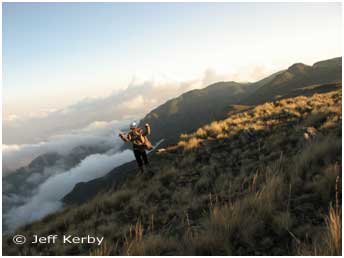 The elevation at Guassa ranges from 3200-3600 meters above sea level (m asl), with the field station situated at ~ 3480 m asl, in the heart of the main gelada study band’s home range. At 111 km2, Guassa is a large and unusually pristine alpine grassland that has been conserved by one of the few surviving ancient indigenous conservation initiatives on the African continent. Guassa’s unusually pristine ecological condition can be attributed to a unique indigenous conservation initiative called the Qero system. Originally instituted by the ancestors of the people living around Guassa nearly 400 years ago, the Qero system carefully regulates exploitation of the grassland specifying when grass can be grazed by livestock or cut to provide thatch roofing for homes. Guassa’s indigenous conservation system is one of very few of its kind in the world that still survives to this day.
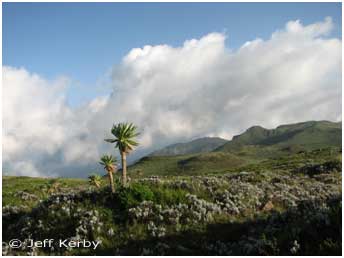 Unlike at other protected sites in Ethiopia where geladas occur, at Guassa there are no permanent human settlements on the grassland. While most of the Ethiopian Highlands has been heavily degraded by livestock grazing and agriculture to the point where grasses rarely reach higher than a few centimeters, Guassa is characterized by tall grasses, a diverse herb assemblage, and myriad flowering plants. The habitat at Guassa therefore probably very closely approximates the habitat in which geladas are thought to have evolved. Currently Guassa supports ~ 2000 geladas (P. Fashing and N. Nguyen, unpub. data), probably the second largest population of geladas in the world after Simen Mountains National Park where ~2500 geladas are thought to remain in a heavily disturbed and degraded habitat (Beehner et al. in press Ethiopian Journal of Science).
About Geladas
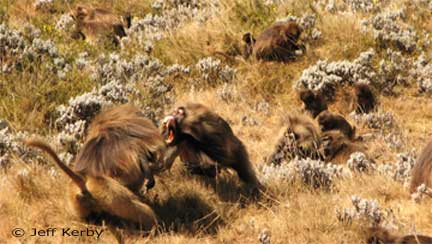
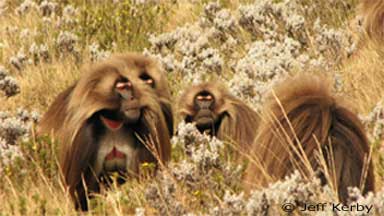 Three males threatening a lone male geladaGelada monkeys (Theropithecus gelada, a distant relative of baboons) occupy a higher altitude and colder climate than any other African primate. They are ecologically, phylogenetically, and behaviorally distinct from other primates yet little is known about them. Geladas are today found only on the alpine grasslands of the Ethiopian Highlands. These highlands are a center of endemism for many plants and animals, including the Ethiopian wolf (Canis simensis), Walia ibex (Capra walie), and gelada monkey. Conservation International recently included the Ethiopian Highlands on their list of the world’s most important but fastest disappearing biodiversity hotspots.
 As the only primate genus endemic to Ethiopia, as well as one of the few primate genera endemic to any one country, geladas represent the ideal primate flagship species for the conservation of the Ethiopian Highlands. Several factors intrinsic to geladas make them extremely vulnerable to future declines, including intense human population pressure across the species’ limited distribution, a high degree of ecological specialization and their formation of huge noisy groups. Given the paucity of original habitat remaining in the Ethiopian Highlands, the last stronghold of the gelada, studies of the species’ behavior and ecology are urgently needed to raise awareness about its plight and that of its unique moorland habitat.
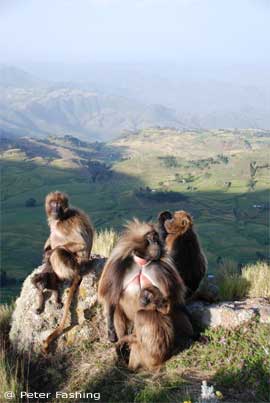
Geladas exhibit an unusual multi-tiered social organization, one found in few other primates. The basic unit of gelada society is the one-male unit (OMU), which typically consists of one adult male, several adult females and their dependent young. The second tier of gelada society is the band, which consists of multiple OMUs that share a common home range. OMUs often temporarily fission from or fuse with one another, and the cluster of OMUs observed together at any one time is known as a herd. Herds exhibit extremely wide variation in size.
About the Research
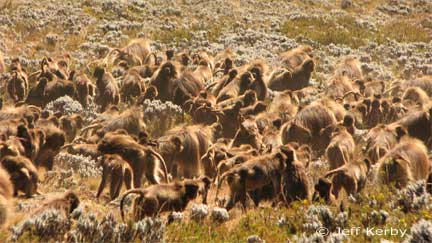
Our main gelada study band at Guassa consists of approximately 220 individuals, though herd size fluctuates on at least a daily basis at this site (range: 34 - 622 individuals). We collect a variety of data at Guassa and virtually all of these data are collected on individually recognized animals, so observers must learn the identities of the geladas in our main study units at the beginning of their research.
 The most basic data we collect are the monitoring records. We currently monitor (year-round) the demographic and reproductive status of over 100 individually recognized adult animals in 14 one-male units (OMUs) on a near-daily basis at Guassa with the help of volunteer research assistants. While study animals are now well-habituated to the presence of human observers, the mountain climate and rugged terrain at Guassa and the species’ fission-fusion social structure (in which OMUs fission and fuse with other OMUs on a near-daily basis) mean that not all units are seen each day. Nevertheless, we visually assess the reproductive status of nearly 60 adult females and record all births, deaths, immigrations, and emigrations occurring in each of the study units each day they are seen.
 In addition to monitoring data, we also collect data for a variety of ongoing projects. We record data on gelada ranging behavior using a handheld GPS device and monitor rainfall and temperature at camp on a near-daily basis. We also conduct monthly habitat assessments in order to monitor changes in food supply for geladas at Guassa. Because geladas are long-lived primates, these data must be collected over a many year period. However, they are essential for monitoring changes in demography, reproduction and ecology in what is probably the most important wild gelada population remaining in a relatively intact ecosystem. We also conduct focal animal samples to collect data on patterns, frequency and duration of social behaviors of interest, including grooming, agonistic interactions, and parenting. We collect the majority of our data using a custom software program written by James Ha, Ph.D. at the University of Washington for Palm devices. We also collect, opportunistically, fecal samples from individually recognized animals in the study population for later laboratory hormonal analyses. Currently, we are studying reproductive and stress physiology in the Guassa geladas – These data will no doubt provide fresh insights into the reproductive and stress physiology of other Old World primates, including humans.
About Gelada Camp
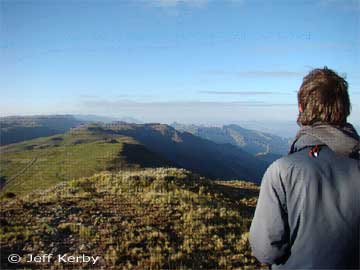
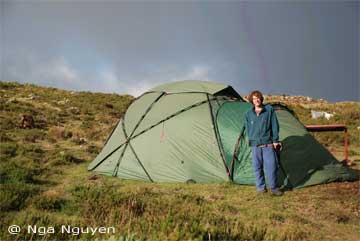 Gelada Camp is located in Guassa’s southern sector, far from human habitation, ~22 km from the nearest town (Mehal Meda) and ~300 km from Addis Ababa, Ethiopia’s capital. Camp is situated in an open alpine grassland along the eastern edge of the Ethiopian Highlands and affords spectacular views out over the Great Rift Valley nearly a mile below. A great assemblage of alpine flowers can be found in bloom at any given time in Camp and alpine flower enthusiasts will find much to love about the Camp’s environs. Nearly all people living in the Guassa area are Amhara, speak Amharic Peter outside his tent at camp(the second most spoken Semitic language in the world after Arabic), and have had little prior contact with the outside world.
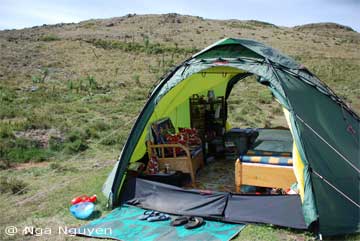 Life at Camp is basic but comfortable by local standards. Because of the ancient prohibition against permanent human settlements on the Guassa, Gelada Camp has no permanent structures. Researchers live in a tented camp with, at any given time, two Ethiopian staff. One staff member guards camp and also helps with the cooking and washing. The other staff member acts as a scout in the field with the geladas.
The amenities at Camp include a large kitchen tent with a propane gas stove, several large sleeping tents with beds and mattresses, desks, and chairs, and solar panels to provide solar electricity to power lights in each tent and other small electronic equipment, including a laptop computer, a small freezer in the office tent for the storage of fecal sample extracts, a satellite radio and portable DVD player. Communication in the field is aided by two-way radios (i.e. “walkie talkies”), and occasional communication with the outside world is possible through satellite telephone and satellite email. For human waste, we use a pit or compost toilet, dug several meters deep and covered on either side of a narrow opening with logs. This type of toilet is a safe and clean way to dispose of human waste in areas of the world without a sewer system and where more permanent structures cannot be built (in Guassa’s case, in keeping with the ancient injunction against the building of permanent structures on the grassland). As a consolation for the rustic ‘facilities’, camp boasts what must surely be some of the most scenic views from any toilet in the world! The water we use at camp is collected from local streams and is carried to camp in large plastic jugs with the aid of donkeys. The water is purified using a water purifier prior to drinking, but can safely be used for cooking and washing without prior purification. Camp also boasts the Guassa region’s largest collection of English language books and DVDs.
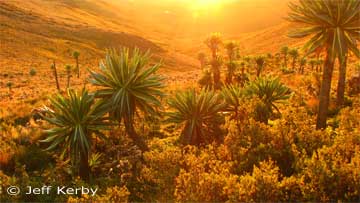 The weather at Guassa is oftentimes unpredictable, with days characterized by some combination of sun, fog, rain, or wind while nights tend to be cold. Temperature at Guassa fluctuates widely over the course of almost any single day, invoking the old adage about African alpine ecosystems – “summer every day, winter every night” (Hedberg 1964. Acta Phytogeographica Suecica 49: 1 – 144, Uppsala). To cope with the unpredictable weather at Guassa, researchers often dress in many layers. In 2007 the Camp weather station reported mean daily high temps of 16.0+1.6 °C and mean daily low temps of 4.2+1.0 °C, for an overall mean temp of 10.1 °C for the year. The warmest month was May with both the highest high temps (averaging 18.2+1.2 °C) and highest low temps (averaging 5.9+1.0 °C). The lowest high temps occurred in November (averaging 14.7+2.3 °C) and the lowest low temperatures occurred in December (averaging 0.1+1.1 °C). Also in 2007, 1794 mm of rain fell at Gelada Camp, probably an unusually high rainfall for the area. Most of this rain was concentrated during only 3 months, July (474 mm), August (531 mm), and September (267 mm), though substantial amounts of rain fell during much of January through June as well. From our experience at Guassa, the weather appears to vary widely from year to year, with some years characterized by less rain and fog and more sunshine than others.
About Day to Day Life at Guassa
Geladas range over a wide area and have highly unpredictable ranging patterns, so we must follow them on foot from the moment they rise from their sleeping cliffs to the time they descend the cliffs to bed. Most of our herd’s main sleeping cliffs are within 15-60 minutes walk from camp, so we typically depart camp around 7AM and begin the trek back to camp around 6PM. These long days with the monkeys are far less grueling and far more productive than searching for lost geladas (for days or weeks) across their entire alpine home range after they have slipped from sight. We work in teams of at least twos and each researcher typically spends two days with the geladas and one day at camp.
On gelada-watching days, we collect a variety of data throughout the day, including, but not limited to, (1) a daily census of all known individuals present on any given day as soon as we arrive at the sleeping cliffs each morning, (2) a daily assessment of reproductive status via visual inspections of the sex skins of all known adult females, (3) focal animal samples of a subset of all the known individuals, and (4) GPS location data for the entire day’s herd at regular intervals. The geladas usually emerge from their sleeping cliffs around 8AM and by mid-morning begin to gradually ascend the steep hillsides to the more gently undulating plateau where they typically spend most of their day. The sloping hillsides leading up to the plateau are grueling first thing in the morning (especially at the high altitude), however, observational conditions on the plateau are generally excellent and time spent up there is often our favorite part of the day. The geladas are extremely active and we almost never have time to sit down. We usually eat a quick lunch of peanut butter or tuna sandwiches in the afternoon whenever there is a lull in the gelada action. By around 4PM, the geladas begin their descent from the plateau to their sleeping cliffs and we follow the herd until we know where they will sleep that night. After a brisk hike back to camp in the waning light of the day, we usually eat dinner (soup, spaghetti, or stir-fry) together in the kitchen tent around 7:30PM and rehash the day’s events. We all typically retire to our tents around 8:30PM where we download the day’s data onto the camp computer and proof-read the data and then read, listen to music or watch DVDs before bed.
On camp days, in addition to rising late, we help clean up around camp, check the equipment and tents for damage, process fecal samples, proof or enter data, and prepare weekly and monthly progress reports about the previous week’s or month’s accomplishments when the time comes. Needless to say, a day in camp can be just as work-intensive as a day out with the geladas.
About Opportunities for Field Research
 Students and other researchers interested in studying geladas at Guassa are encouraged to contact us to discuss possibilities for future research and collaboration. Some funding is available for students in the M.A. program at California State Fullerton; more advanced researchers would need to obtain outside funding to conduct their research at Guassa.
We also have openings for up to 3 volunteer field research assistants at Guassa each year. These assistantships are ideal for those who (1) enjoy life outdoors, (2) have a keen interest in wildlife biology and (3) wish to gain experience observing animals in the wild and working as a part of an active field research team. Because the training process requires 2-4 months, assistants must be willing to work for a minimum of 13-months. Interested in participating in the work we do at Guassa? Please contact Peter Fashing or Nga Nguyen for more details.
Contact Us
Peter J. Fashing, Ph.D.
Co-Director, Guassa Gelada Project
Dept. of Anthropology
California State University, Fullerton
P.O. Box 6846
Fullerton, CA 92834
Email: peterfashing@gmail.com
Nga Nguyen, Ph.D.
Co-Director, Guassa Gelada Project
Dept. of Anthropology
California State University, Fullerton
P.O. Box 6846
Fullerton, CA 92834
Email: nganguyen@fullerton.edu